Departure and Arrival
Here I stand, on the platform at Llanfairfechan, looking north out to sea, waiting for the train to London. When it arrives I get on, but soon change my mind. At Chester I change for Cardiff and journey on, until again I change my mind. Day’s end, I find myself in Cornwall — looking south, out to sea.
The platform my studio, the sea my easel. London what I set out to draw. I draw and become dissatisfied with what I draw, in part through the feeling that I am unable to render what it is that I set out to draw, but primarily because the subject no longer attracts me. And this is strange — my London. I chose my subject from a photo, a sketch, something remembered or felt; it drew me and I decided that it is what I will draw. But once I start drawing, like a dead thing, it fails to attract me. I have been there; I have seen it before. It is too easy. I’m disappointed. I’m bored.
I could walk away at that point but do not. With my hand, I dust over London. Watch it fade in the smog. Tabula almost rasa.
Through smoothed-out charcoal I pick out remains — see what feels like Cardiff — move on. And so it goes, though as yet I have no real idea where it’s going. I scrape back, layer, incise, erase. Scrape back, layer, incise — work through dissatisfaction — watch and wait for something to appear. Usually it does, this thing that was perhaps latent all along: hard rock, wet green, sea, a junction of buried tracks. When I see it, I stop.
In his novel Septology, Jon Fosse articulates something akin to this process:
‘…one of the most important things when it comes to painting is being able to stop at the right time, to know when a painting is saying what it can say, if you keep going too long then more often than not the picture’ll be ruined… a picture … should come to you on its own, like something that just happens, like a gift, yes, a good picture is a gift and a prayer of gratitude, I think and I never could have painted a good picture through force of will, because art just happens…’
Art does not come effortlessly and nor does it come because it is called. It emerges through labour, uncertainty, failure, repetition and waiting. When a drawing comes too quickly, it dies. Coherence hardens into inertia and dissatisfaction drives me back into the surface. I erase, layer, scrape back and wait again. Eventually something appears that could not have been consciously planned. It is not invention, nor execution — it is encounter.
The subject is not London or Cornwall. The subject is the journey between them.
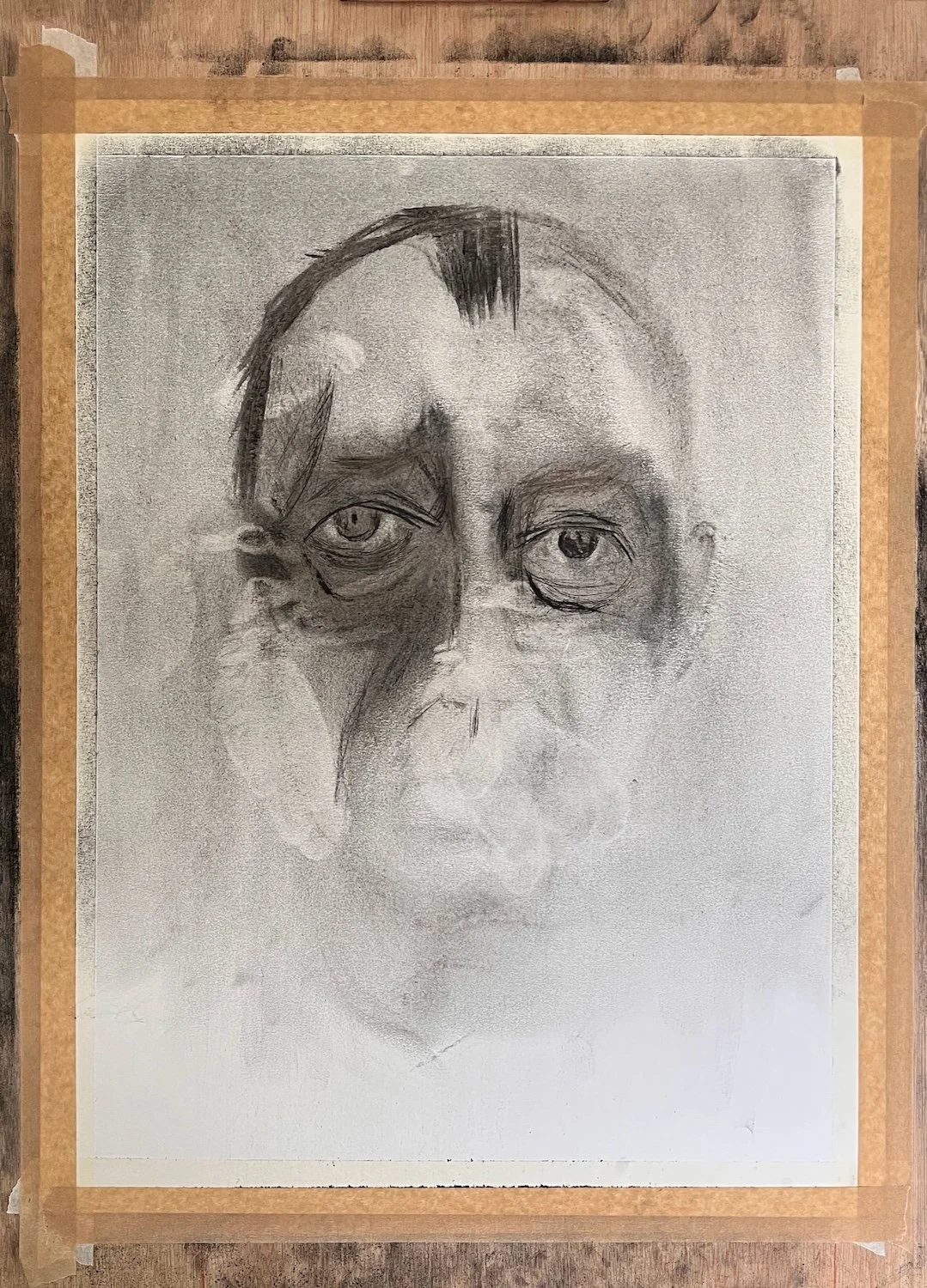
Mute. Charcoal on paper, 50 × 38 cm, 2026.